
Nonprofit Events Planning Checklist

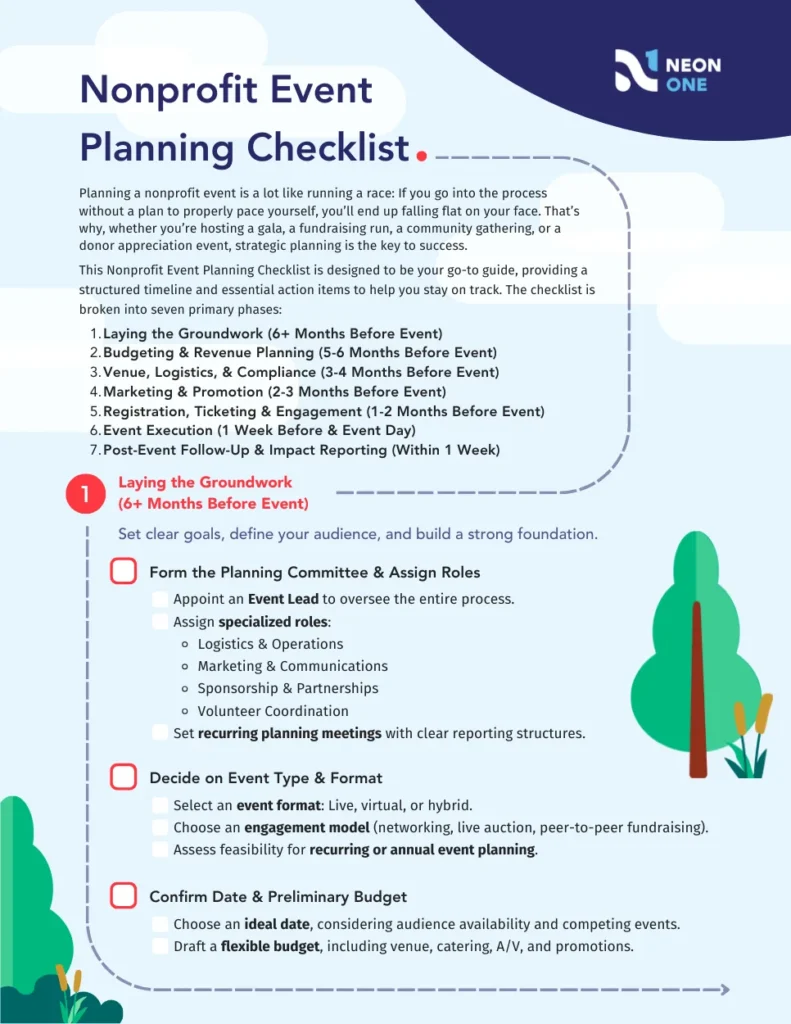
A nonprofit event planning checklist is a phase-by-phase task list that moves a small nonprofit from goals and budget through day-of execution and post-event follow-up. Start with a written goal and budget; assign an owner and deadline to every task; confirm permits, insurance, and Internal Revenue Service (IRS)-compliant donation records before promoting the event. This phase-by-phase approach works for a fundraiser, a community event, or a volunteer-run program at small and mid-size U.S. nonprofits.
Before You Start: Goals, Budget, and Legal Baseline
Set the written baseline before booking a venue: a measurable goal, a working budget, and the legal requirements that apply to your state. A board-approved written plan keeps the event lead accountable when quotes change or a volunteer drops out. If your organization is new to event planning, the About Nonprofit Roundtable Desk page explains the editorial standards behind these guides.
Set the goal and audience first
- Choose one measurable outcome: net revenue, confirmed attendees, or registrations completed, not general awareness.
- Name the audience; a donor dinner and a volunteer recruitment event need different venues and materials.
- Write the goal in one sentence and put it at the top of the planning document.
- Bring the goal to the board or a program committee early; a board-approved target makes later trade-offs easier.
Build the budget with a contingency line
A contingency budget is a working budget with a reserved line for costs that arrive late; it is not a padding line buried in program costs.
- List venue, insurance, permits, supplies, printing, promotion, and staff or contractor time.
- Add a contingency line for quote changes and cancellations; do not hide it in program costs.
- Approve the budget in writing before committing to a venue.
- If a funder or grant covers part of the event, confirm the grant terms before signing the venue contract.
Confirm 501(c)(3) receipts and solicitation registration
Charitable contribution substantiation starts with IRS Publication 1771: a written acknowledgment is required for donations of $250 or more, and it must state the amount and whether the organization gave any goods or services in return. Donations are deductible only when made to a qualified organization under IRS Publication 526. Before soliciting in a state, confirm charitable solicitation registration with state charity officials; NASCO, the National Association of State Charity Officials, lists state offices and requirements, which vary by state.
The Master Timeline: Six Months Out to Day 30 After
Use this table as a master schedule; each row needs one owner and one deadline. Adjust the dates to the enrollment cycle of your audience and the lead time of your venue. The sequence below doubles as a nonprofit fundraising event checklist for a gala, a community fair, or a volunteer recruitment day.
| Task | Owner | Deadline |
|---|---|---|
| Set goal, budget, target date; designate event lead; brief the board | Executive director or event chair | T-6 months |
| Secure venue; confirm permits, general liability insurance, accessibility review | Event lead | T-5 months |
| Pitch sponsors with one-page options; confirm recognition terms | Development lead | T-4 months |
| Lock speakers, menu, A/V, volunteer leads; send save-the-date | Volunteer coordinator or communications lead | T-6 weeks |
| Confirm RSVPs, print materials, brief volunteers, verify donation receipt language | Event lead | T-2 weeks |
| Final walk-through, weather/cancellation decision, confirm vendor arrivals | Event lead | Event week |
| Signage, check-in, volunteer stations, donor acknowledgment table, incident contact | Volunteer coordinator | Event day |
| Send thank-you notes and receipts for qualifying donations; reconcile budget actuals | Development or finance lead | +7 days |
| Calculate ROI, debrief volunteers, log sponsor follow-up for next cycle | Executive director | +30 days |
The table works for a fundraising gala or a low-budget volunteer event; the difference is scale, not the sequence. Assign a named person to each row, not a committee, and put the deadline in the shared calendar.
Low-Budget and Volunteer-Run Events
Small nonprofits can run a solid event on a $5,000 working cap if the venue is donated and promotion is email-only. Treat the $5,000 as a ceiling; obtain local quotes before setting line items. A low-budget event still needs the same legal baseline: permits, insurance, and receipt-ready donation records.
| Line item | Low-budget approach |
|---|---|
| Venue | Donated community space ($0) |
| General liability insurance | Obtain a local quote; some venues include it in the agreement |
| Supplies and signage | Donated or low-cost materials; allocate only after written quotes |
| Printing | Minimal program and sign-up sheets; print at a library or office |
| Promotional materials | Email and social posts; skip paid advertising |
| Contingency | Reserve a line for week-of costs; do not spend it early |
For a donor event, replace paid catering with a pre-event sponsorship: a local restaurant can cover food in exchange for naming in the program. For a volunteer recruitment event, a donated community room and sign-up sheets may be enough; the budget line for insurance and permits remains.
Accessibility and Safety Checks Before You Book
The Americans with Disabilities Act (ADA) Title III covers places of public accommodation and commercial facilities; ADA.gov is the primary source for requirements.
- Confirm an accessible entrance and route from parking to the main room, including an elevator or ramp if the event is not on the ground floor.
- Check accessible seating, assistance for hearing or speech, and a clear route to restrooms.
- For a speaker event, include an interpreter or live captions if participants request them; budget the service before promoting the event.
- Write a rain plan or cancellation clause into the venue contract, including who decides and when.
- Confirm emergency exits and a named incident contact for the day of the event.
Marketing and Sponsor Follow-Up
Set sponsor and promotion deadlines inside the master timeline so they do not become last-minute tasks.
- Pitch sponsors at T-4 months with one-page options; confirm logo and recognition before sending save-the-date.
- Send save-the-date at T-6 weeks and event details at T-2 weeks.
- Send email reminders to registered attendees the week of the event and on the day before.
- After the event, thank sponsors in writing and include the attendance or net result that matters to them.
After the Event: ROI and Donor Stewardship
Close the loop within 30 days. Calculate cost per dollar raised with this formula:
Cost per dollar raised = event expenses / net funds raised
A ratio above $1.00 means the event cost more than it raised before accounting for long-term donor value; it does not by itself decide success. Record donor stewardship separately from event revenue: send written thank-you notes and, for donations of $250 or more, the acknowledgment described under IRS Publication 1771. Track a first-time attendee who gives $25 as a potential repeated donor, not as a one-time line item.
Frequently Asked Questions
What should a nonprofit event checklist include? A goal and audience, a budget with contingency, venue, permits and insurance, volunteer roles, promotion, and post-event follow-up.
How far in advance should a nonprofit event be planned? Six months for a fundraising event that needs sponsors, permits, and a paid venue; six to eight weeks is the minimum viable window for a small volunteer-run event.
Do charity events need insurance or permits? Generally yes. Most venues and municipalities require general liability insurance and a permit; requirements vary by state, venue, and event size.
What receipts does the IRS require for event donations? A written acknowledgment for donations of $250 or more, stating the amount and whether any goods or services were provided in return, as covered in IRS Publication 1771.
How do you measure the ROI of a nonprofit event? Use the formula: cost per dollar raised equals event expenses divided by net funds raised; track donor retention separately.
Sources
Primary sources: IRS Publication 1771, Charitable Contributions: Substantiation and Disclosure Requirements; IRS Publication 526, Charitable Contributions; ADA.gov; and NASCO, the National Association of State Charity Officials.
This guide is general information, not legal, tax, or insurance advice. Consult a qualified attorney or tax professional for decisions about your organization.
Keep reading