
Nonprofit Crisis Communication Plan: A 7-Step Guide

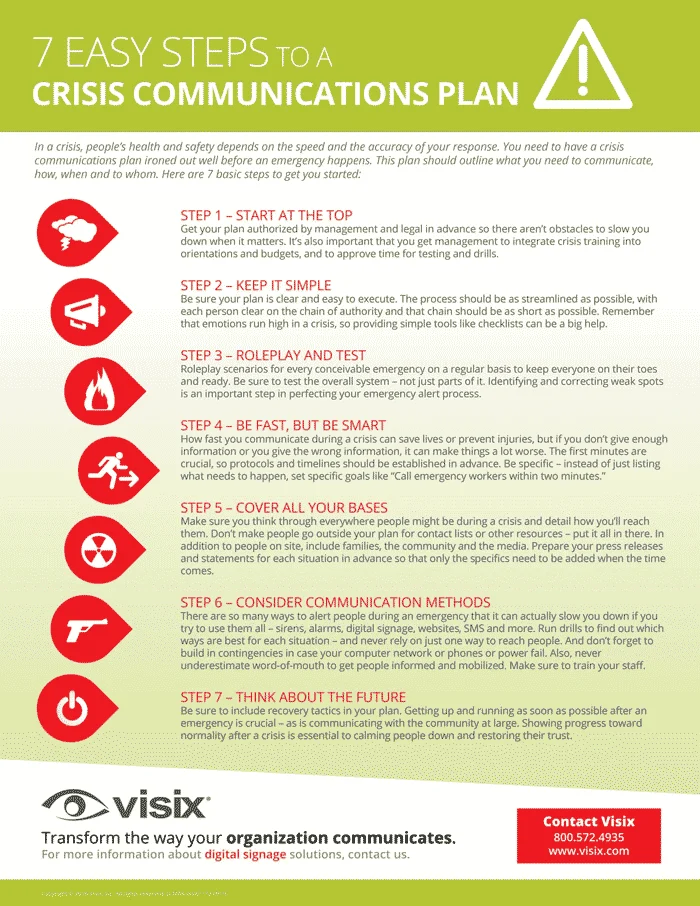
A nonprofit crisis communication plan is a short document that says who decides, who speaks and who gets called first when something goes wrong. It lists a response team, a spokesperson, a 24/7 contact list and draft messages for staff, the board, funders, donors and the press. Review it once a year.
A small organization can write the first version in an afternoon. The steps below, the roles table and the two sample statements are enough to start.
What is a nonprofit crisis communication plan?
A nonprofit crisis plan is a written set of decisions made in advance: which events count as a crisis, who forms the response team, who speaks for the organization and in what order people are told. Writing it before an incident means nobody has to invent those answers under pressure.
It is not the same as a continuity plan. The communication plan covers what you say and to whom. The continuity plan covers how the organization keeps operating, and Ready.gov describes it in terms of teams, tasks and testing.
Typical triggers include a government shutdown that delays a federal award, the loss of a grant, a data breach, misconduct by a staff member or board member, and a natural disaster that closes your office.
How do you build a nonprofit crisis communication plan?
Build it in seven steps, grouped by when they happen: before a crisis, during it and after it. Each step produces something you can put on a single page.
Before a crisis
- List your scenarios. Write down the five or six events most likely to hit your organization, such as a funding freeze, a breach or an executive departure. For each one, note who would be affected first.
- Name the response team and backups. Choose a decision-maker, a spokesperson and one person each for the board, funders and data. Every role gets a named alternate in case the first person is unreachable.
- Pick the spokesperson for communication skill, not title. The Nonprofit Risk Management Center (NRMC) notes that the top executive is not automatically the right voice. Look for someone calm who can repeat the core message whatever the question.
- Build the contact list. Collect names, mobile numbers and email addresses that work at night and on weekends. NRMC calls this a crisis telephone directory; keep a paper copy as well as a digital one.
- Prepare a fact sheet and holding statements. A fact sheet is one page of verified background on your mission, programs and leadership. Holding statements are draft messages with blanks for the details of the event.
During a crisis
- Tell people in order. NRMC suggests widening circles: first the people closest to the crisis and key decision-makers, then employees and volunteers, then the people you serve, then the wider community. Detail thins as the circle grows.
After a crisis
- Log, update and review. Keep a record of every reporter who called and what they asked. Afterward, note what worked, fix the plan and update the contact list.
Who does what in a nonprofit crisis?
Five or six roles cover most small organizations, and one person can hold more than one. What matters is that each role has a named backup. The titles below are generic; fill in your own names.
| Role | What it does | Backup |
|---|---|---|
| Decision-maker | Declares the crisis, approves every outside message | Board chair or deputy |
| Spokesperson | Speaks to the press and answers public questions | A second trained speaker |
| Board liaison | Briefs board members and relays their questions | Another officer |
| Funder liaison | Contacts grantmakers and agencies, checks award terms | Finance or program lead |
| Data and IT lead | Secures systems, assesses what was exposed | Outside IT provider |
| Record keeper | Logs decisions, times and press calls | Administrative staff |
Then add a contact list with one row per person or group, using the same fields every time:
- Name and role
- Mobile number reachable 24/7
- Personal and work email
- Who calls this person, and in what order
- Last date the entry was checked
Include the board, key funders and agency program officers, your largest donors, your insurer, your attorney or outside counsel, and a short list of local reporters.
What do you tell donors, funders and the press?
Tell them what you know, what you are doing about it and when they will hear from you next. Leave out speculation and anything you have not confirmed. A short, accurate message sent early beats a long one sent late.
For funders, start with the agreement. If the money is federal, the terms of your award and your awarding agency's own rules govern how a disruption affects payments or reporting, so read the award documents and contact your program officer first. Notify the funder in the way and time frame your agreement sets out.
Use the same structure for every audience and change only the detail. These two templates work as a crisis communication plan template for nonprofits; replace each bracket with confirmed facts.
Donors: "We are aware of [what happened] and are working to [action]. Your gifts and information [are / are not] affected as far as we know. We will update you by [day and time] at [channel]."
Press: "On [date], [organization] learned that [confirmed fact]. Our priority is [people served or safety]. [Name], our spokesperson, will share more by [time]. Please direct questions to [contact]."
Reporters work on deadline. A one-page fact sheet and a named contact answer most of what they need in the first call.
How does a continuity plan fit in?
A nonprofit continuity plan keeps programs and payroll running while you respond, and the communication plan is one part of it. Ready.gov lays out six steps: prepare, define objectives, identify risks, develop strategies, define teams and tasks, and test the plan.
A small organization can start with one sheet: critical functions, who performs them, where records are stored and who has the passwords. Test it once, then fix what failed.
General information only, not legal, tax or financial advice.
FAQ
What should be in a nonprofit crisis communication plan?
A response team with backups, one spokesperson, a 24/7 contact list, the audiences in order, draft messages, a fact sheet and a review date.
Who should speak for a nonprofit in a crisis?
One named spokesperson chosen for communication skill, not title, with a trained backup. Everyone else sends media calls to that person.
How often should we update the plan?
At least once a year, and again after any incident, staff change or new funder agreement. Check every phone number each time.
Do small nonprofits need a crisis plan?
Yes. A one-page version with roles, backups and a contact list is enough to start, and you can add scenarios and messages later.
Sources
- Ready.gov, Business Continuity Planning (updated March 2026): the six planning steps and the focus on teams, tasks and testing.
- Nonprofit Risk Management Center, Communicating During a Crisis: spokesperson selection, crisis directory, prepared materials, audience order and press log.
Keep reading